
When the Government backed away from taxing testamentary trusts, many families breathed a sigh of relief. The legislation introduced into Parliament in mid-October tells a more complicated story, and anyone whose will contains a testamentary trust should take note.
From “death tax” to backflip
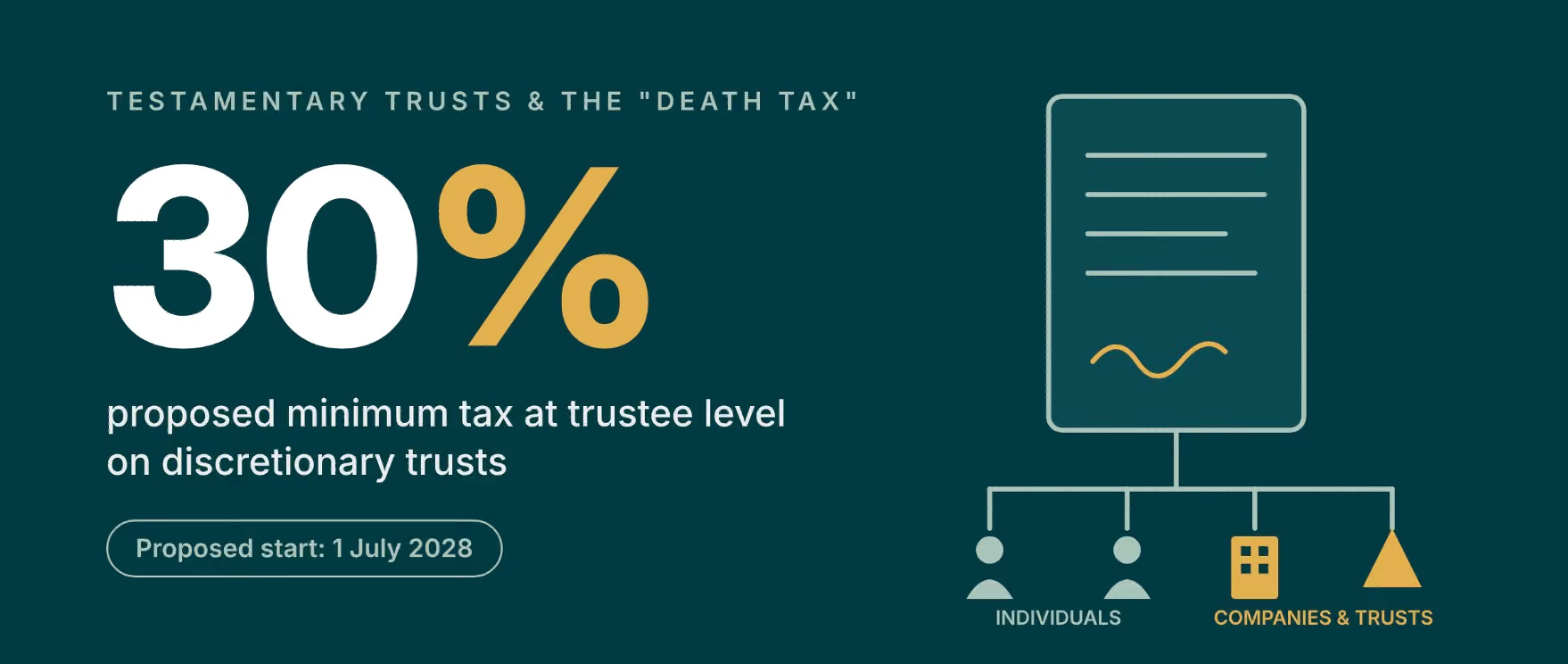
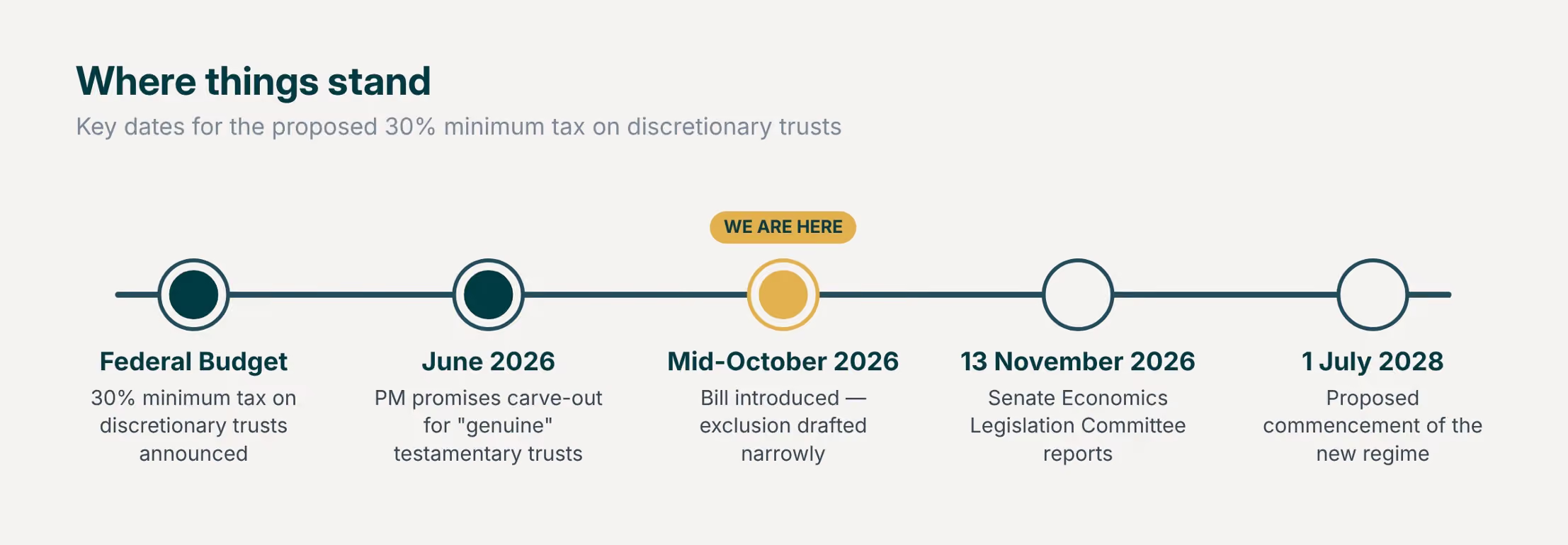
In the Federal Budget, the Government proposed a 30% minimum tax at trustee level on discretionary trusts, to apply from 1 July 2028. As first announced, the measure would also have caught testamentary trusts. These are trusts created under a will that take effect on death, and families have long used them to protect inherited wealth, prevent minors who receive estate income from being taxed at penalty rates, and give executors and trustees flexibility in how income is distributed.
The backlash was swift, and the measure was quickly dubbed a “death tax”. The Government backflipped, with the Prime Minister committing that trusts established for genuine testamentary purposes would be carved out. When the Treasurer introduced the legislation into Parliament in mid-October, that exclusion was there. The trouble is in how it has been drafted.
The fine print
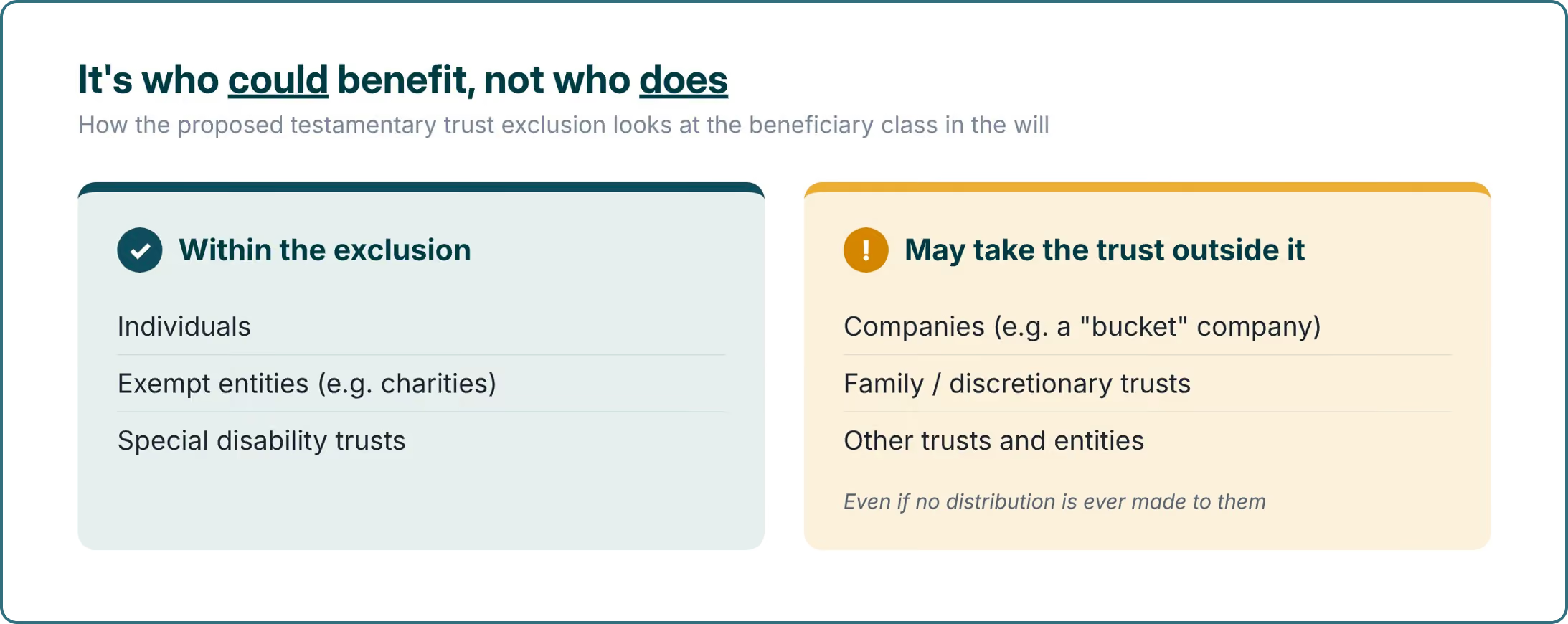
As currently drafted, the testamentary trust exclusion appears to require the beneficiaries under the trust instrument to be limited to individuals, exempt entities and special disability trusts.
Many wills, including carefully drafted wills prepared over many years, deliberately include companies, family trusts and other trusts within the class of potential beneficiaries. That flexibility has long been regarded as good estate planning practice.
Critically, the test appears to turn on who could benefit under the trust, not who actually receives a distribution. A testamentary trust could therefore fall outside the exclusion simply because a company or another trust is included in the beneficiary class, even if no distribution is ever made to it.
If the exclusion is not available, the trust may be exposed to the 30% minimum tax. There is also a potential double-tax problem for corporate beneficiaries: the company may not receive a credit for the tax paid by the trustee, and may then be taxed again on the distribution it receives.
As reported in The Australian Financial Review on 16 October 2026, advisers across the profession have warned that many existing wills may need to be reviewed as a result.
Who should be paying attention?
- Anyone whose will establishes one or more testamentary trusts, particularly where the beneficiary class extends to companies or other trusts.
- Families who are currently preparing or updating their wills.
- Executors and trustees of testamentary trusts that have already come into existence following a death.
- Older family members, and those for whom revisiting a will later may be difficult because of health or capacity.
Trusts that are already in operation need particular care. It cannot be assumed that an existing testamentary trust can simply be amended. Any variation must take account of the trust terms, the trustee’s powers, trust law, and potential capital gains tax, stamp duty and other tax consequences.
Where is the legislation up to?
The Bill has been referred to the Senate Economics Legislation Committee, which is due to report by 13 November 2026. That is the committee’s reporting deadline, not the date of a Senate vote, but it should give a much clearer indication of whether the Bill will pass and whether the testamentary trust provisions are likely to change. The first scheduled Senate sitting period after that is 23 to 26 November 2026. The legislation could therefore progress quickly after the committee reports.
There is a way through, but it isn’t one-size-fits-all
The good news is that there are practical options, and for most families the issue can be managed well ahead of the proposed 2028 start date. Our Wills & Estates and Tax teams have been working through the Bill closely and have developed a considered approach for clients whose wills contain testamentary trusts.
The right answer, however, depends on your circumstances: how your will is drafted, the companies and trusts that sit around your family’s wealth, your age and health, and how much flexibility you want your executors and trustees to keep. For some clients, the timing of any changes matters as much as the changes themselves. A rushed rewrite could cost flexibility you don’t need to give up, while doing nothing could leave your family exposed.
If your will includes a testamentary trust, or you are a trustee of one, now is the time to get advice tailored to your position.
Contact Brendan O’Keefe or Danh Nguyen to arrange a confidential discussion.
Important information
This article is general information only and does not constitute legal or tax advice. The proposed measures are subject to the passage of legislation and may change. Current as at 28 October 2026.